A harmful algal bloom warning on the Charles River now stretches further upstream after state health officials expanded the advisory on Friday, Aug. 28.
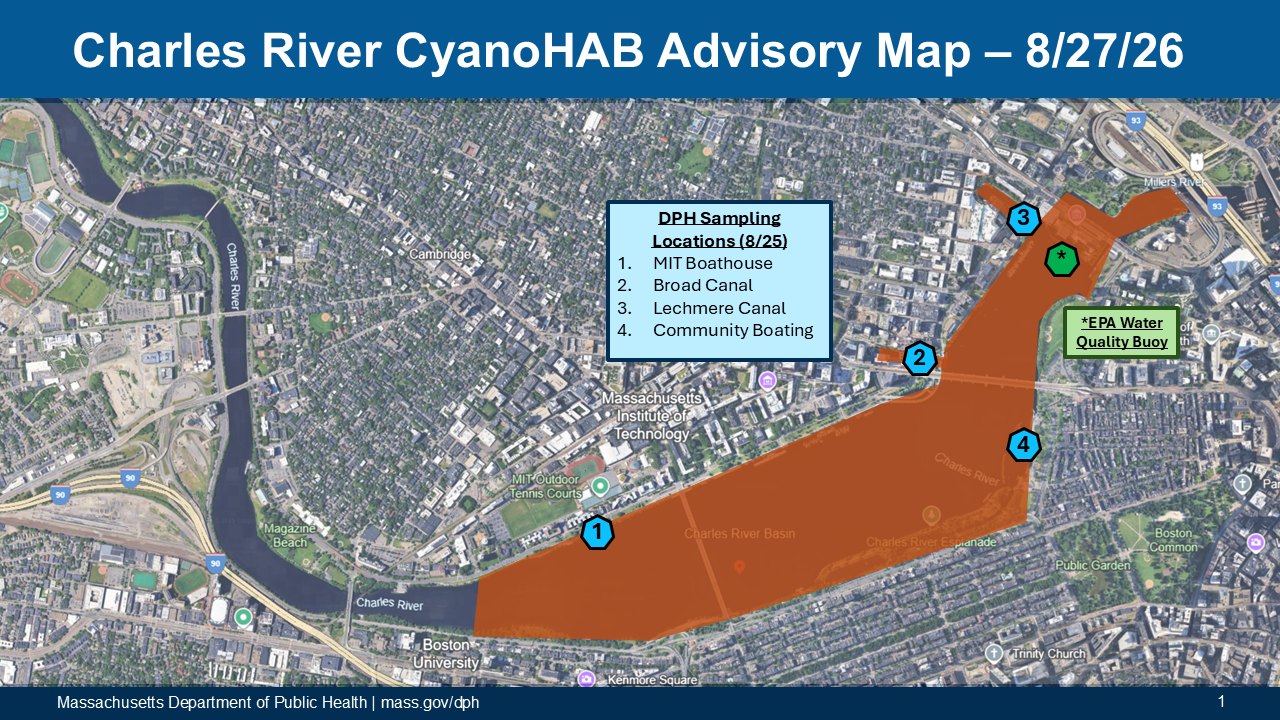
The Massachusetts Department of Public Health (DPH) pushed the boundary of the cyanobacteria advisory from the Harvard Bridge upstream to the Boston University Duan Family Center for Computing & Data Sciences Building, informally known as the "Jenga Tower." The advisory covers everything downstream of that building to the mouth of the Charles.
The expansion widens the off-limits zone on the lower basin, a stretch used by rowing clubs, paddlers and dog walkers across the metro area, including from Newton.
How the bloom was found
Charles River Watershed Association (CRWA) River Science Extern Marielena Lima performed water sampling and microscope analysis on Aug. 19 and found high cyanobacterial concentrations in the lower basin, according to a CRWA advisory authored by Carly Sherman. Lima notified DPH, which conducted a site inspection to visually confirm the bloom.
DPH issued the initial advisory on Aug. 21, covering the river downstream of the Harvard Bridge, also known as the Massachusetts Avenue Bridge. The Friday expansion pushed the boundary roughly a half-mile further upstream.
What residents should know
The bloom is dangerous. Exposure to cyanobacterial blooms can cause serious health effects and can be fatal to pets, according to CRWA.
Health officials advised pet owners to call a veterinarian immediately if an animal develops vomiting, drooling or convulsions after contact with the river, the Boston Public Health Commission said. Symptoms can appear soon after exposure. Dogs are at particular risk because they may eat algae that washes ashore or clings to their fur.
Anyone who touches the water or shoreline algae should rinse off right away.
DPH staff confirmed that cyanobacteria levels in the river exceeded state guidelines for recreational waterbodies. Those guidelines recommend advisories when cell counts top 70,000 cells per milliliter or when toxin concentrations pass set thresholds. The state notes it is impossible to tell whether a bloom is toxic just by looking at it.
No end date set
No lift date has been announced. The state's active advisory list includes the Charles River Lower Basin. Residents can check the CRWA and DPH websites for updates on when the water will reopen.