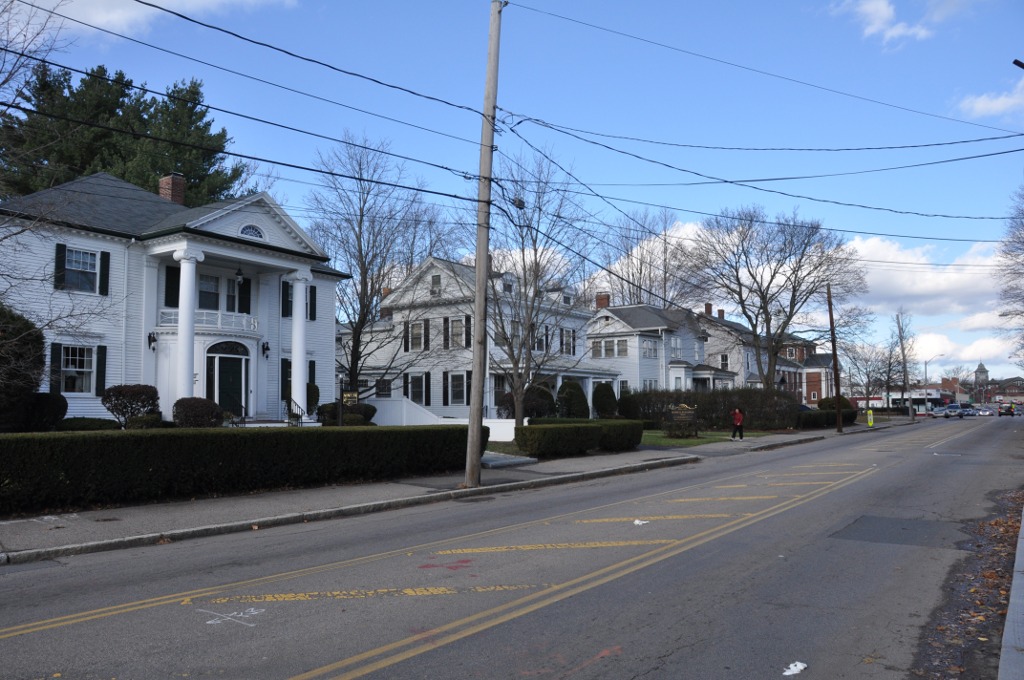
Newton property owners can now expand buildings that exceed their lot's floor area ratio without city approval, under a state zoning law change that Assistant City Solicitor Andrew Lee called a significant shift at the Zoning and Planning Committee's Monday, Sept. 14 meeting.
The change to Massachusetts General Laws Chapter 40A, Section 6, eliminates the requirement that homeowners seek a special permit finding from the City Council before extending or altering structures that are nonconforming due to lot size, lot shape, frontage, lot coverage or floor area ratio (FAR). Those expansions are now allowed by right, though they must still comply with current rules on height, stories and setbacks.
Lee told the committee that under the new law, a property owner could even tear down a nonconforming house and rebuild with a larger FAR. "They could tear down the house and build a new one with no requirement for a Section 6 finding to increase the FAR," he said, adding that owners could not add units.
Multiple councilors voiced concern.
A second shift in the same law lowers the bar for obtaining a zoning variance. Under Chapter 40A, Section 10, the Zoning Board of Appeals (ZBA) can now grant a variance when strict enforcement would cause "practical difficulty" for the applicant. The old standard required proof of "substantial hardship" tied to soil conditions, shape or topography. Lee told the committee that "practical difficulty" is not currently legally defined and that no one knows exactly what it means.
Newton's ZBA has already applied the new standard. In a July 13 hearing, the board granted a variance for a microfulfillment center exceeding 10,000 square feet at 241-247 Riverview Ave., writing in its decision that strict enforcement would result in a practical difficulty.
At the committee's Aug. 17 meeting, incoming ZBA alternate Dante Capasso said the changes were still very new and that more variance applications would have to play out before anyone could say the standard had been truly lowered. Incoming ZBA member Christopher Markiewicz said at the same meeting that he does not believe the new language necessarily lowered the bar and that every petition needs to stand on its own merits.
Lee said he expects fewer requests for Section 6 findings going forward. A councilor noted that state representatives would be willing to hear whatever changes Newton's council might recommend to address unintended consequences.
BU rezoning review continues
The committee also continued its review of Docket Item #57-26, a request to align dimensional controls for residential developments in business-zoned lots. The item has been held three times since February, and the committee voted 7-0 on Sept. 14 to hold it again.
Senior Long-Range Planner Amanda Wolfe cautioned that rezoning parcels from commercial to residential could lower economic opportunity for landowners and shrink the potential commercial tax base. She also warned that rezoning may create more nonconformities, which under the new state law would give property owners more zoning flexibility.
The committee reviewed specific parcels across six wards, including sites on Chestnut Street, Boylston Street and Hale Street in Ward 5; Auburndale Avenue, River Street, Watertown Street, Cross Street and Parsons Street in Ward 3; Melrose Street in Ward 4; Brentwood Avenue and Carthay Circle in Wards 6 and 8; Saw Mill Brook Parkway, Hanson Road and Colella Road in Ward 8; and Peabody Street in Ward 1. A February Planning Department analysis found 133 residential-use parcels in commercial zones citywide, with 94 in Ward 1's Nonantum neighborhood.
Chair Baker said the committee should have one more working session before the rezoning proposals are advertised, including discussion of how the new state law will affect the Nonantum parcels. No date for that session has been announced.