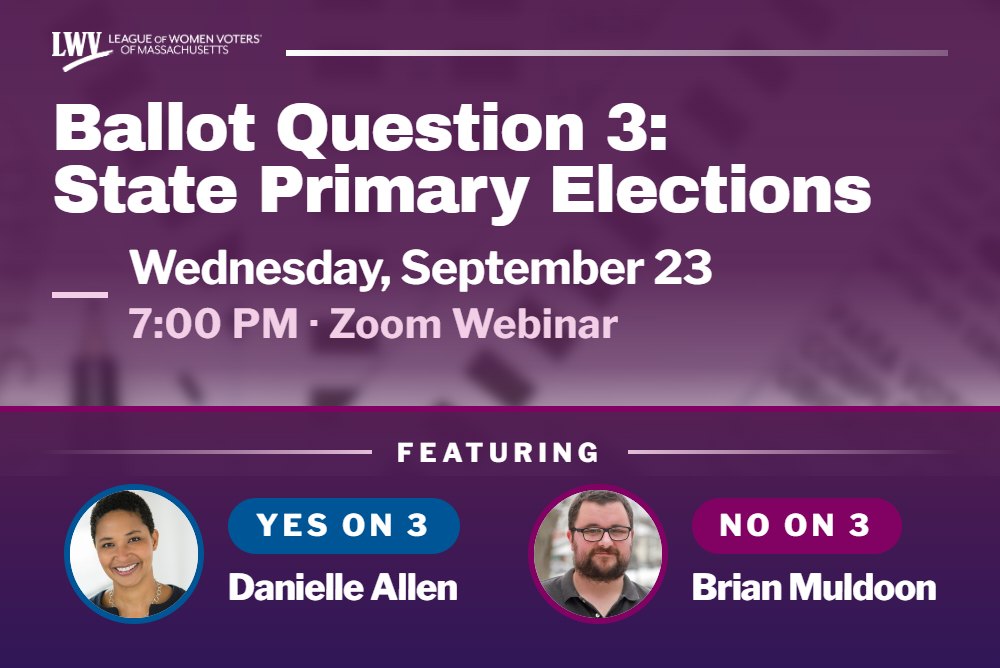
Newton residents can hear the case for and against overhauling Massachusetts primary elections at a free Zoom forum on Wednesday, Sept. 23.
The League of Women Voters of Massachusetts is hosting the event from 7 to 8:30 p.m. to explain Ballot Question 3, which would eliminate separate Democratic and Republican primaries for state and congressional offices. In their place, all candidates would appear on a single primary ballot regardless of party, with the top two vote-getters advancing to the general election. Presidential primaries would not change.
Danielle Allen, a Harvard University professor and convening chair of the Coalition for Healthy Democracy, which filed the ballot question, will represent the Yes on 3 Campaign. Allen briefly ran in the 2022 Democratic primary for governor. Brian Muldoon will represent the No on 3 Campaign.
If approved by voters on Nov. 3, the new system would take effect starting in 2028.
Residents who want to submit questions for the forum must do so by Friday, Sept. 18, through the League of Women Voters of Newton event page. Registration for the Zoom event is also available there.
What Question 3 would change
The Yes on 3 campaign argues the current system leaves too many races uncontested. The State House News Service found that voters will have a real choice in only 82 of the state's 200 legislative seats this year, according to Winchester News.
Prominent backers include former Gov. Deval Patrick, former MassGOP chair Jennifer Nassour and the NAACP New England Area Conference, CommonWealth Beacon reported.
The opposition spans both major parties, labor unions and progressive groups. The Massachusetts Democratic Party, the Massachusetts Republican Party, Progressive Mass, Act on Mass, the American Federation of Teachers Massachusetts chapter and 32BJ SEIU have all signaled opposition, according to CommonWealth Beacon.
Jordan Berg Powers, chair of the No on 3 campaign committee, told CommonWealth Beacon on Aug. 20 that "hating jungle primaries is maybe the most bipartisan issue in America."
A UMass Amherst/WCVB poll of 800 registered voters conducted Aug. 5–12, also reported by CommonWealth Beacon, found 51 percent leaning toward yes, 32 percent leaning toward no and 17 percent undecided.