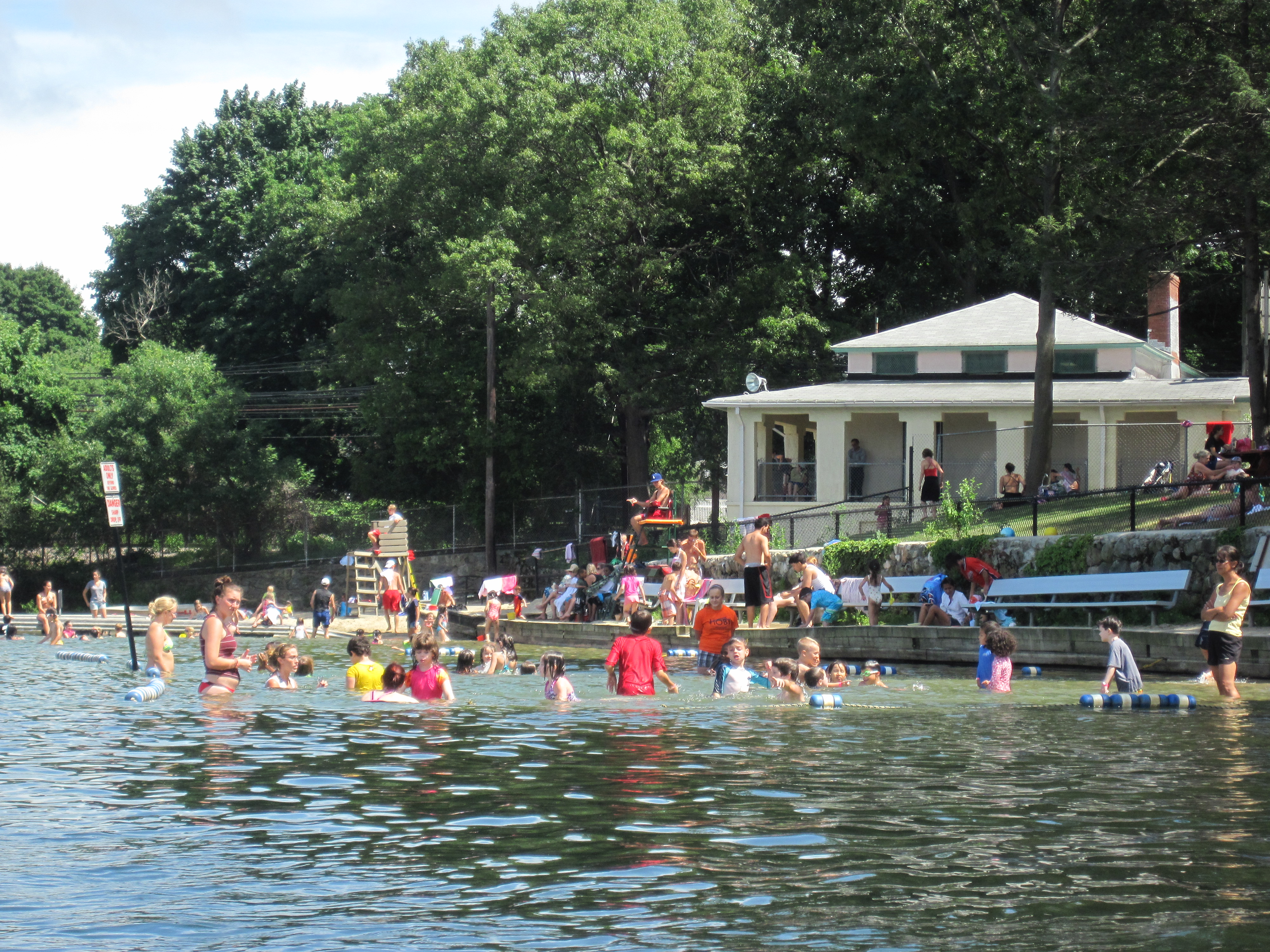
Crystal Lake's two swim-season closures during summer 2026 may share a common cause: rising temperatures driven by climate change.
That is the argument Lucia Baum-Vardi, a Newton resident and student at Buckingham Browne & Nichols School, laid out in an analysis published Monday, Sept. 14 by Green Newton, the city's environmental nonprofit. Baum-Vardi connected the lake's back-to-back shutdowns to peer-reviewed research showing warmer water fuels the bacteria and algae that forced Newton families out of the water.
"The closing is disappointing for many residents and is the latest in a series of issues with the lake that have concerned my family," Baum-Vardi wrote.
The lake's troubles started in late June, when a cyanobacteria bloom shut down swimming. The beach reopened July 2 after Parks & Recreation Deputy Commissioner Mark Kelly drove to a testing lab in Connecticut to pick up materials and expedite results.
Then E. coli surged. City water-quality data shows the Aug. 5 sample hit 660 colony-forming units (CFU) per 100 milliliters, nearly three times the 235 CFU safety limit. After a brief dip, levels spiked again: 700 CFU on Aug. 12 and 860 CFU on Aug. 13. Mayor Marc Laredo announced Aug. 14 that the lake was closed for the season, two days ahead of the scheduled Aug. 16 final day. He warned that no people or pets should have contact with the water.
Crystal Lake was one of 35 Massachusetts beaches closed as of Aug. 14, according to Boston.com.
Baum-Vardi cited a 2016 study in the Journal of Infectious Diseases that found E. coli concentration grows 8% for every degree Celsius of monthly temperature increase. She also pointed to a U.S. Environmental Protection Agency (EPA) resource linking warmer water and higher carbon dioxide levels to cyanobacteria growth. Both conditions, she argued, trace back to a warming climate.
Crystal Lake is a kettle pond with no headwaters. It is fed primarily through stormwater runoff from impervious surfaces, which carries leaf litter and organic debris that raise phosphorus levels. The city treated the water with alum and sodium aluminate in April to reduce phosphorus, following similar treatments in 2020 and 2022, according to city water-quality records.
Baum-Vardi wrote that a warming climate "seems to be the underlying reason behind the recent closures in Crystal Lake, not only this year but in previous seasons as well."
No city meeting or study specifically addressing the climate-lake connection appears in available public records. The 2026 swim season has ended.