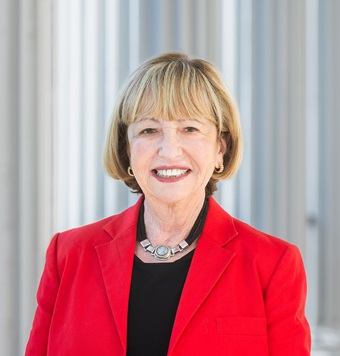
Sen. Cynthia Creem told a Newton North High School student interviewer that several climate bills she championed are in conference committee, including measures on urban tree planting, street-tree protections and plastic packaging.
Creem, who chairs the Senate Committee on Climate Change and Global Warming, outlined the legislation in an Aug. 26 interview published Sept. 21 by Green Newton. The environmental group plans to honor her at its Environmental Leadership Celebration on Oct. 1.
Amelia Zhang, a Newton North High School junior and Green Newton intern, conducted the interview.
Among the bills Creem described as in conference committee negotiations:
- The Municipal Reforestation Act, which would help cities and towns develop tree-planting programs.
- The Public Shade Tree Act, which would give municipal tree wardens stronger tools to protect street trees.
- Plastic packaging legislation that would direct restaurants to provide disposable plastic food-service items only when customers request them.
- Dark Skies legislation requiring publicly funded outdoor lighting to meet standards for reducing light pollution.
- A gradual phaseout of the Gas System Enhancement Program (GSEP).
- An environmental bond bill authorizing billions of dollars for clean-air and clean-water initiatives. The Mystic River Watershed Association identified that bill as the "Mass Ready Act" in a July 30 report.
Creem described GSEP as expensive and wasteful. She said she is working to establish a working group to recommend changes to the program.
On gas-system reform more broadly, Creem said she wants to empower ten communities, including Newton, to restrict fossil-fuel use in new construction. She also cited efforts to authorize networked geothermal demonstration projects, including one already operating in Framingham, and to end most Mass Save incentives for fossil-fuel appliances while increasing investment in heat pumps.
Creem said her committee's recent hearings have shaped the Senate's legislative agenda. Those hearings covered federal pullback in climate funding, gas companies' initial compliance plans, carbon sequestration through forests, farms and oceans, solar deployment and the Mass Save program.
Federal obstacles weigh on the effort. Creem said reductions in federal climate funding and the loss of subsidies for cleaner appliances and electric vehicles could make it harder for Massachusetts to meet its targets. She also pointed to a federal government that does not sufficiently acknowledge climate change.
Creem said the state has committed to cutting greenhouse-gas emissions at least 50 percent from 1990 levels by 2030 and reaching net zero by 2050.
Despite those headwinds, Creem said the Legislature and the Department of Public Utilities now approach the gas system with a completely different mindset than when the planning process began.
Green Newton's Environmental Leadership Celebration honoring Creem takes place Oct. 1.